
The Ostrich Inn, Colnbrook: Murder, Ghosts and 900 Years of Mystery


There are historic pubs, and wow, this is a historic inn... then there are haunted pubs... Here at The Ostrich Inn, history and the paranormal activity have become so intertwined that it seems paranormal activity is layered in between the very old beams and the ancient brick work.
The Ostrich Inn at Colnbrook is one of those places that you just know is haunted.
For more than 900 years, travellers have stopped here on the old road west from London. Kings are said to have visited. Highwaymen are reputed to have hidden here. Generations of landlords, staff, travellers and hotel guests have passed underneath its beams.
Somewhere amongst all of the history is one of the most gruesome stories associated with any English inn: the tale of a murderous landlord, a hinged bed, a concealed trapdoor and wealthy travellers supposedly dropped into a boiling cauldron below.
It is the sort of story that would suggest that the building just HAS to be haunted by restless spirits of those tortured souls.
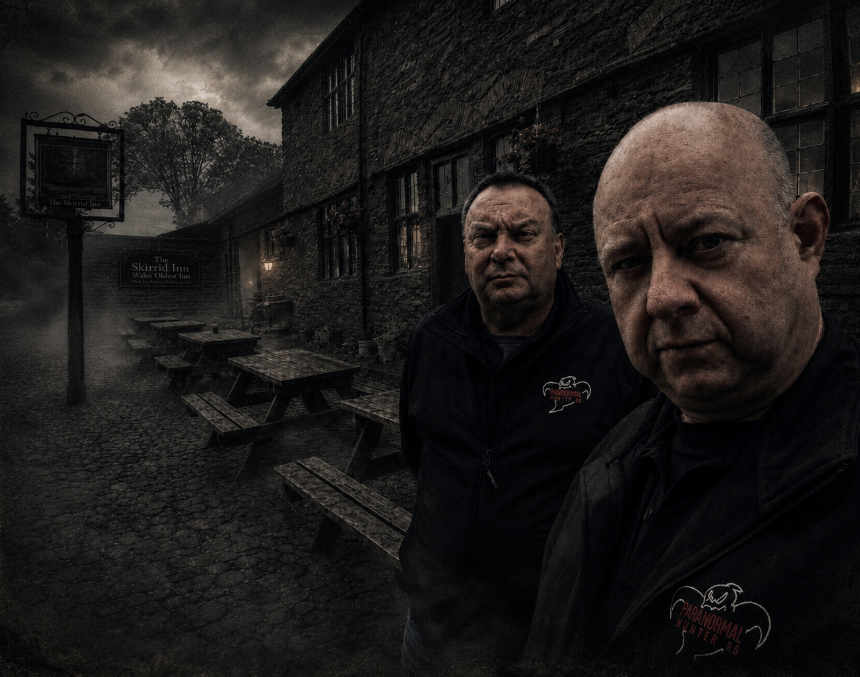
So, as part of our continuing research for Ghosts on Draught, Barry and I travelled to Colnbrook to investigate The Ostrich for ourselves. What we found was intriguing. perhaps though not for the reasons we expected...
One of England's Oldest Inns
The Ostrich stands on the High Street in Colnbrook, close to the old London-to-Bath route. Historic England records that a 'hospice' was founded here by Milo Crispin in 1106, and that it later became associated with The Ostrich Inn. It is consequently reputed to be the third-oldest inn in England.
The surviving timber-framed building itself is principally sixteenth-century and is now protected as a Grade II* listed building. The distinction is important. When we talk about The Ostrich dating from 1106, we are talking about the history of hospitality on the site rather than claiming that every timber standing today has survived untouched for more than nine centuries.
Nevertheless, this is an extraordinarily old location.
Colnbrook itself appears in medieval records long before many of the stories now associated with the pub. Its position made it an important stopping place for people travelling between London, Bath and Windsor, and coaching inns became a significant part of village life. The origin of the name is less certain.
One tradition suggests that Ostrich developed from Hospice over time. Other theories have proposed names such as Eastridge or Ostridge. There is another tantalising possibility in Thomas Deloney's Thomas of Reading, where the inn central to the murder story appears under the sign of The Crane. Crane or ostrich, hospice or inn, the building has had plenty of time to accumulate stories.
King John, Dick Turpin and Centuries of Travellers
Among The Ostrich's numerous legends is the claim that King John stopped here in 1215 while travelling to Runnymede, where Magna Carta would be sealed. The inn itself continues to recount that tradition, although, like many stories attached to buildings of this age, it should be treated as tradition rather than documented certainty, but there is certainly no smoke without fire.
Another famous name connected with The Ostrich is highwayman Dick Turpin, who is reputed to have used the inn while evading the authorities. However colourful and nostalgic these stories are, neither is the story that made The Ostrich notorious.
For that, we need to 'meet' Mr Jarman.
The Terrible, Cruel, Story of Jarman and the Murdering Bed
According to legend, The Ostrich Inn was once run by a landlord and his wife called Jarman. Their most desirable guest room was supposedly reserved for the wealthy travellers arriving there alone. Having been given the VIP treatment, the guest would retire to bed believing himself to sleep soudnly in tghe safety of the Inn, however, he was anything but safe!
According to the story, Jarman had constructed a mechanism beneath the bed. Iron pins could be withdrawn from below, allowing part of the bedroom floor, with the bed upon it, to tip downwards at an angle. Now, directly underneath was the kitchen, and in the kitchen stood a huge cauldron read heated with water or oil.The unfortunate traveller would be tipped from his bed and plunged into the boiling liquid below. Once dead, his body could be disposed of and his valuables stolen.
Some versions of the gruesum legend claim around sixty victims met there end there. It is an extraordinarily horrific story. There is another aspect to this tale...
Thomas Cole and Thomas of Reading
The best-known victim of tyhe Jarmans was supposedly a wealthy clothier called Thomas Cole. Cole's horse was said to have escaped from the inn and later been found wandering without its owner. Suspicion eventually led people back to the inn, Cole's murder was discovered and Jarman and his wife were exposed. It has even been claimed that the name Colnbrook developed from "Cole in the brook" after Cole's body was found in the water nearby, no doubts the Jarmans needed to get rid of the body rather quickly.
However, that particular interpretation is extremely unlikely. Colnbrook was recorded centuries earlier under forms such as Colebroc, generally interpreted in relation to the brook itself. More significantly, the Jarman story can be traced to Thomas Deloney's Thomas of Reading.
Deloney was writing in the late sixteenth century; the work was circulating around the turn of the seventeenth century, with an edition recorded in the early 1600s. In the story, Thomas Cole stays at an inn where the landlord, Iarman/Jarman, murders him using the infamous collapsing bedroom floor.
Now this creates rather a problem.
There is currently no known contemporary documentary evidence proving that Jarman and his wife murdered sixty travellers at The Ostrich or that they were executed for doing so. One historical interpretation therefore regards the whole episode as literary fiction that gradually became attached to the real inn. Yet that does not necessarily mean that the entire tradition can simply be thrown away.
Historian Mike Dash notes an intriguing nineteenth-century account of a much older local tradition involving thirteen murdered bodies supposedly removed from an inn at Colnbrook. He also discusses the possibility that Deloney, a travelling artisan, may have drawn upon existing oral folklore rather than creating every element of the story from nothing.
After hundreds of years, it becomes clearly impossible to determine where one story ends and the other begins. That was the position from which we began our investigation - how exciting!
Before the Investigation: What the Staff Told Us
We deliberately try not to overload ourselves with paranormal reports before an investigation. It is too easy to walk into a building already expecting to experience precisely what somebody has told you is there. Instead, we spoke to members of staff and allowed them to tell us what they had experienced.
And the accounts were considerably more interesting than the Jarman legend alone.
One long-serving member of staff, who had worked at The Ostrich from the age of sixteen, described repeated unexplained incidents throughout the building.
Perhaps the most dramatic occurred in the kitchen.An ice-cream scoop apparently travelled several metres across the kitchen and struck him in the back. His immediate assumption was that another chef had thrown it.
The chef was nowhere near it. The force needed to take that object 5+ metres and not fall in the air means it was not just thrown, it was guided by an unseen force, quite the energy was needed. So, the act was intelligent and powerful AND located in the kitchen area, an area that would have been outside the building previsouly. This becomes important later on.
On another occasion, dishes were seen moving individually from a surface, we saw the video evidence and it does looks slightly odd. Tea towels, coffee pots and other kitchen objects have also allegedly moved or fallen without an obvious cause.
These were not stories handed down, they were described to us by somebody who says he personally witnessed them.
Footsteps in an Empty Pub
There were other accounts too. After closing one evening, three members of staff reportedly heard clear footsteps travelling from one section of the building into another and then returning several minutes later, none of the three was moving.
Another story concerned a man believed to occupy a particular area of the bar.
During a previous paranormal event, a medium reportedly announced that the man had become irritated and was leaving.
At almost exactly that moment, the closed front door apparently swung open and slammed shut. When staff checked outside, nobody was there.
Stories like these interested us far more than a murder legend repeated from a book. They involve identifiable witnesses describing events within living memory.They may ultimately have perfectly ordinary explanations, but they are investigable claims.

The Little Girl
There is also a recurring story involving a child.
Staff described occasions when a young voice had apparently been heard calling out "Mummy."
A knocking at a bedroom door was also reportedly followed by what sounded like a young child outside.
Elsewhere in the building, former staff have reported seeing a small blonde girl, while during refurbishment work a concealed space containing a small table and chairs was apparently uncovered behind part of the building. None of that proves the presence of a child's spirit but the recurrence of the child narrative amongst different accounts was certainly something worth recording.
Music From Another Time
There was another fascinating coincidence.
Part of the upstairs accommodation had once formed a larger function space associated with what staff described as the old music hall. During one paranormal investigation, a medium reportedly said that she could hear old-fashioned music playing. Some weeks later, a hotel guest, apparently unaware of that account, came down at breakfast and reported hearing what she described as old music during the night. Again, anecdote is not evidence of the paranormal but independent reports with similar details are exactly the sort of material we record for comparison against future investigations.
Room 3: The Passageway
We began our investigation downstairs in Room 3.
Almost immediately, we encountered one practical complication.
The electromagnetic field readings throughout parts of the building were very high and fluctuating. At times the meter moved repeatedly between amber and red. High background EMF means that any isolated meter reaction has to be interpreted very cautiously. An old building can contain electrical wiring, equipment and other environmental sources capable of producing exactly the readings paranormal investigators sometimes become excited about.
We could not simply treat every fluctuation as paranormal. We discontinuned the use of the K2 meters because the whole building had high background readings of EMF.
Something else happened in Room 3, however, that was interesting from an investigative point of view. I had the impression of movement travelling laterally through a particular area, almost as though something were repeatedly passing from one side to another.
Only afterwards did a member of staff tell us that while staying in that room she had once seen what appeared to be a person walk across the same area and apparently continue through what is now a wall.
There may be a perfectly conventional explanation but as an example of an impression being followed by previously undisclosed witness information, it was certainly worth noting.
Room 11: The Most Active Room of the Night
We then moved upstairs to Room 11. Historically, this is particularly interesting because staff identify it with the room associated with the old murder tradition and the space above the former kitchen/cellar area. If we were expecting a terrible atmosphere, however, we did not get one. The room did not feel threatening.
Yet instrumentally and visually, it became the busiest room we investigated that evening.
We recorded numerous small airborne light anomalies on camera, what paranormal investigators commonly refer to as orbs.

We are cautious with these Orbs. Dust, insects, moisture and infrared illumination can all create orb-like images, particularly on night-vision equipment. Simply photographing a white circle is not evidence of a ghost.
What caught our attention were some objects that appeared highly regular, moved rapidly or seemed to travel in association with one another. Several moved together and turned in time, others pulsated, slowly moving, then quickly zipping away... We also recorded larger, less sharply defined anomalies that looked almost like tiny pieces of cotton wool moving through the image. Again, these are observations rather than proof of paranormal activity.
Room 11 nevertheless produced enough material to warrant detailed review. More personally, I felt something touch the top of my head while standing in one part of the room.
On another occasion I felt a pull on my jacket.
Neither experience can now be independently demonstrated, and therefore neither should be presented as concrete evidence, yet they happened, and they form part of the investigation record.
The King John Suite: Almost Nothing
From Room 11 we entered the King John Suite. The contrast was striking because it felt extraordinarily peaceful in the room. Barry and I both commented on how comfortable and restful the room seemed. There were occasional airborne anomalies on camera, but very little else occurred.
For a building with such a reputation, sometimes the most useful result is precisely that: nothing happened.

Room 10
Room 10 produced a similar impression to room 11 and had a bery similar feeling. There appeared to be slightly more activity than in the King John Suite, but nothing particularly dramatic. We later learnt that Room 10 had historically formed part of the adjoining larger space.
That made the similarity in atmosphere interesting, although not evidential.
We then entered Room 9.
Everything changed.
Room 9: An Overwhelming Sadness
Room 9 was, for me, the most emotionally distinctive room in the building, it wasn't frightening, nor was it malevolent.
The room simply felt, Sad.
There was an immediate sensation of emptiness and emotional weight that was difficult to articulate. I remember thinking that I would not be surprised if somebody entered that room and inexplicably felt tearful. Barry experienced cold sensations while we were there, and several of the airborne anomalies we were observing appeared around his position.
My strongest impression was that something distressing had been witnessed in that room.
That is an intuitive experience rather than a measurable finding, and it needs to be described as such.
Interestingly, it brought us back to the accounts involving the little girl.
Whether the two things have any connection, we simply do not know.

Back Downstairs
Later in the evening we returned to the main bar areas.
Using dowsing rods, we attempted communication.
Dowsing is something we use experimentally rather than as proof: ideomotor movement provides a well-established conventional mechanism through which rods can move unconsciously, so answers obtained this way cannot independently establish facts.
Nevertheless, the session produced a narrative worth documenting. Responses appeared to indicate several distinct presences within different parts of the building.
At one stage our questioning produced a figure of approximately ten.
More intriguingly, when we asked about the legendary murderer, the responses suggested two victims, that is interesting because it ran contrary to the famous story.
However, it would be completely wrong to take a dowsing response and rewrite history from it. We therefore record it simply as: the answer obtained during the session.
Nothing more.
What Is Beneath the Floor?
During the same session I had an impression that bodies might once have been beneath part of the floor, little was I to know that the dowsing rods suggested it was in the kitchen area!
We wondered nervetheless whether there might be some form of void beneath the area because of changes in floor levels and the way different sections of the historic building join together.
Trigger objects appeared to respond during some of this questioning. Again, however, this is precisely where paranormal investigation needs restraint. Intuition only.

Someone Was Moving in the Kitchen
One of the more curious episodes happened in the kitchen. Equipment had been set up and members of the group were together when we heard what sounded like somebody moving in the kitchen area behind us.
More than one person noticed the movement, and another sound was subsequently heard again from the kitchen.
On leaving the investigation area for a moment, I also noticed that the atmosphere within the main bar seemed markedly different from earlier.
Several of us independently commented on it, a changed atmosphere is subjective..
The unexplained movement in the kitchen was more interesting... yet without a recording that positively identifies its source, it remains unexplained rather than paranormal.
The Kitchen: Someone Was There
For me, the kitchen became one of the most intriguing areas of the entire investigation. That was already significant because, before we began, staff had repeatedly identified the kitchen as one of the principal hotspots in the building. This was where objects had reportedly moved, where an ice-cream scoop had apparently travelled several metres across the room, where tea towels and other items had seemingly been displaced, and where staff regularly reported a sense of activity.
During our investigation, something happened which made those accounts considerably more interesting. The chef had left the area and, shortly afterwards, the outside light came on.
Then we heard movement.
Not a vague creak from this old building. It sounded as though somebody was physically moving around outside the kitchen.
Our immediate assumption was obvious: it was the chef.
Except it wasn't!
When he returned, we asked him directly and he was absolutely clear that he had not gone outside.
That presented another problem. The door between the kitchen and outside has a distinctive sound when it opens and closes. Had somebody physically walked through it, we should have heard it. We hadn't.
Yet we all had heard somebody moving outside and the light had come on.
For those few moments, there appeared to be someone in an area where, as far as we could establish, nobody was actually present. The light came on and we just accepted that it was the chef.
It was one of those incidents that sounds relatively insignificant when reduced to a sentence, we heard someone moving outside, but being there was very different. We knew where everybody was. We knew where the chef had been. We knew what that door sounded like.
BUT something really had moved around out there...
Two Bodies Beneath the Kitchen?
Later, while working with the dowsing rods in the same general area, I began to develop a very strong impression that this part of the building was important for another reason.
I felt with certainty that two bodies had at some point been disposed of in or around the kitchen area.
This was an intuitive impression rather than a historical fact, and the responses obtained through dowsing cannot independently establish that anybody was buried or concealed there.
But the number was interesting.
The traditional Jarman story speaks variously of nine victims, sixty victims or even more depending upon which retelling is followed.
What we were getting was very different.
Two.
I began wondering whether this might explain why the kitchen appeared to contain some of the strongest activity in the building.
If something remained there, was it connected with those two people? Or was there another possibility?
The Jarman murders have become part of the identity of The Ostrich Inn. The story has been told and retold for centuries. People arrive knowing about the murderous landlord, the tipping bed and the boiling cauldron.
Could whatever we were encountering somehow be connected not simply with the events themselves, but with the legacy of the story? Was someone or something trying to protect the area?
We had no way of knowing.
Then something happened which made the whole exchange considerably stranger.
“I've Been Caught Out”
As I explained my impression about the two bodies and what might have happened in this part of the building, the chef jokingly remarked:
“I've been caught out.”
I laughed and replied with words to the effect of:
“Yep, you've been caught out.”
Then Barry's expression changed, he looked at us, visibly unsettled.
“Who said that the third time?”
For a moment, neither of us understood what he meant.
The chef had said it, and I had responded.
Barry was adamant that he had heard the phrase again.
A third voice appeared to have joined the conversation.
None of us claimed it. There was nobody else standing with us who should have said it. Was it an acoustical effect? Had one of our voices echoed strangely around the old kitchen? Had Barry simply interpreted another sound as speech?
Those possibilities have to remain on the table and there is another possibility too. Had somebody else been listening?
For just a moment, had they decided to join in and tell us the truth?
We cannot say that a spirit spoke to us in the kitchen of The Ostrich Inn. What we can say is that three of us were having a conversation in an area already associated with repeated reports of unexplained activity; two phrases were knowingly spoken and Barry was convinced that he heard a third.
Combined with the unexplained movement only a short time earlier, it turned the kitchen into one of the most significant locations of our first investigation.
Perhaps more importantly, none of it gave us evidence for sixty murders. If anything, what emerged from that night's investigation was something rather different. Again and again, the number two seemed more relevant now than sixty.
Whether that is coincidence, unconscious influence or a fragment of an entirely different story hidden somewhere within The Ostrich's long history remains unknown.
But it gives us a very good reason to go back.

A Final Return to Room 11
Before finishing, we returned to Room 11.
Considering how active it had appeared earlier, it was remarkably quiet. A small number of airborne anomalies were observed, including what appeared to occur around attempts to invite whatever might be present to approach us.
The intensity of our first session there had gone.
Then our investigation drew to a close.
So, Did Jarman Murder Sixty People at The Ostrich?
We don't know. Based upon the historical evidence presently available, nobody else can confidently say that he did either.
The story of Jarman, Thomas Cole, the hinged bed and the boiling cauldron can demonstrably be traced through Thomas of Reading, while historians have pointed out that documentary evidence for the sixty murders and the supposed execution of Jarman is lacking.
There are older strands of local murder folklore that prevent the wider tradition from being entirely uninteresting. Perhaps Deloney invented the story or that he embellished something he heard. Perhaps an unrelated event became attached to The Ostrich over centuries of retelling or perhaps several different traditions have simply merged into one extraordinarily effective legend.
"Our investigation cannot answer that question."
Importantly, we found no paranormal evidence during this first visit that independently substantiated the story of Jarman's sixty murders.
That does not mean the story has been disproved, it means exactly what it says, that we did not find evidence for it.
Is The Ostrich Inn Haunted?
The strongest material from this investigation was not a ghost appearing before us or a device spelling out the name Jarman.
Instead we found a collection of smaller things, staff members describing apparently moving objects; footsteps where nobody could be seen; reports from hotel guests apparently unaware of previous experiences; a recurring child motif; unexplained sounds during our own investigation; distinctly different atmospheres between rooms; physical sensations that we could not verify; and substantial quantities of video material from Room 11 that still require careful scrutiny.
Some of those things may have mundane explanations.
Almost certainly, some of the visual anomalies we recorded will, becuase this is why we investigate.
We are not there to make everything paranormal, no, we are there to find out what remains when the normal explanations have been considered.
Our Verdict After the First Investigation
The Ostrich Inn deserves another visit. Not because we can claim to have proved that sixty murdered travellers haunt its rooms, we can't.
Not because every orb, cold sensation or unexplained noise must have been a ghost. It deserves another investigation because there are still questions here, one evening doesn't fulfull an investigation. It is a jigsaw you are putting together.
The staff testimony is real testimony, whatever ultimately caused the experiences being describe and during our own investigation, Room 11 in particular produced enough unexplained activity to make us want to go back.
Perhaps that is ultimately more compelling than simply repeating the old legend. Nine hundred years of travellers have passed through The Ostrich. Perhaps Kings, and highwaymen? Definitely merchants, landlords, servants, families, drinkers and guests have all left something of themselves behind, if only in the stories people continue to tell.
Whether anything else remains there is a different question.
After our first night at The Ostrich Inn, we don't yet have the answer.
We would very much like to return and ask again.
The Ostrich Inn, Colnbrook was investigated on 20 September 2026 as part of our research for Ghosts on Draught, our forthcoming exploration of Britain's haunted pubs.
Thank you for reading. Please subscribe and share, and if you’d like to keep us fuelled through those long nights of investigation, you can support our work by joining the:
Midnight coffee Club


Comments